
Evipo018
| Denomination: | 'Evipo018' |
|---|---|
| Trade name: | Bourbon |
| Botanical Name: | Clematis viticella |
| Applicant/Holder: |
Poulsen Roser A/S Kratbjerg 332 DK-3480 Fredensborg Denmark Tel: 45 48 48 30 28 Raymond J. Evison, Ltd. Domarie Vineries, Les Sauvagées, St. Sampsons Guersney Channel Islands GY2 4AF United Kingdom |
| Breeder: |
Mogens N. Olesen, Poulsen Roser A/S, Fredensborg, Denmark Raymond J. Evison, Raymond J. Evison, Ltd., Channel Islands, United Kingdom |
| Agent in Canada: |
Miller Thomson Pouliot LLP 1000 De La Gauchetière Street West, Suite 3700 Montréal, Quebec H3B 4W5 Canada Tel: 514-871-5449 |
| Application Date: | 2006-02-28 |
| Application Number: | 06-5253 |
| Grant of Rights Date: | 2010-06-28 |
| Certificate Number: | 3889 |
| Exemption from compulsory licensing: | Yes |
| Expiry date for exemption from compulsory licensing: | 2012-06-28 |
| Date rights surrendered: | 2016-06-22 |
Variety Description
Variety used for comparison: 'Evifive' (Liberation)
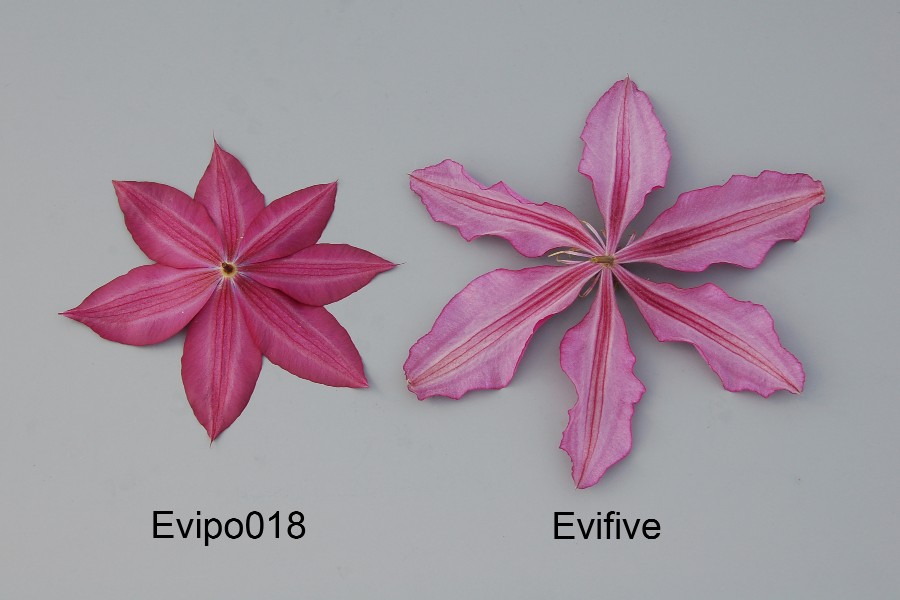
Summary: 'Evipo018' has a broader leaf blade and smaller flower diameter than 'Evifive'. The shape of the leaf blade of 'Evipo018' is ovate with an acute apex and cuspidate tip while it is lanceolate with an acuminate apex for 'Evifive'. In lateral view, the shape of the flower in cross-section is concave for 'Evipo018' while it is flat to convex for 'Evifive'. Arrangement of the sepals of 'Evipo018' ranges from touching to overlapping while it is not touching for 'Evifive'. 'Evipo018' has smaller sepals which are lighter in colour towards the middle of the upper side while those of 'Evifive' are lighter towards the margin. The lower side of the sepal of 'Evipo018' is reddish violet whereas it is violet for 'Evifive'. 'Evipo018' has weaker undulation of the sepal margin than 'Evifive'. The colour of the filament is white for 'Evipo018' while it is light violet for 'Evifive'.
Description:
PLANT: climbing type, strong vigour
YOUNG SHOOT: dense pubescence
LEAF: simple type
LEAF BLADE: ovate shape, acute apex with cuspidate tip, obtuse base, entire margin, no lobes, medium green on upper side, no variegation, weak rugosity of upper surface
FLOWER: solitary arrangement, upward facing attitude, single type, rotate shape, cross-section in lateral view is concave, weak fragrance
SEPAL: six to eight per flower, arrangement is touching to overlapping, elliptic shape, concave to flat in cross-section, curvature in longitudinal-section is absent to moderately reflexed, acuminate apex, type two base, two colours on upper side, upper side is purple (RHS 71A) with lighter purple (lighter than RHS 70A) central bar and reddish purple (RHS 61A) central veins, lower side is reddish violet (more red than RHS N77B) with purple (RHS 61A) veins along central bar, weak undulation of margin, no twisting along longitudinal axis
PETALOID STAMINODE: absent
FILAMENT: white
ANTHER: yellow
Origin & Breeding History: 'Evipo018' originated from a cross made in Guernsey, England during the spring of 1995 between two unnamed seedlings. The resulting seed was germinated in January of 1996 and the seedlings were evaluated under controlled conditions during the following summer. After this initial evaluation, the new variety was assigned a breeding code, and reproduced by asexual propagation from vegetative cuttings. The objective of this hybridization was to create a new and distinct variety for commercial glasshouse and nursery culture with medium sized red purple flowers, compact growth habit, yellow flower center and attractive "tulip-like" flower buds during the initial opening of the flower.
Tests & Trials: Trials for 'Evipo018' were conducted outdoors during the spring and summer of 2009 at BioFlora Inc. in St. Thomas, Ontario. It included 8 plants of the candidate and reference varieties. All plants were grown from bare-rooted plants which were transplanted into 11.5 cm pots on December 10, 2006. All plants were transplanted in the field on May 29, 2007. They were spaced 0.7 meters apart and trained to grow along a trellis. Observations and measurements were taken from 8 plants or 10 parts of 8 plants of the candidate and reference varieties on June 9, 2009. All colour determinations were made using the 2001 Royal Horticultural Society (RHS) Colour Chart.
Comparison tables for 'Evipo018' with reference variety 'Evifive'
Leaf blade width (cm)
| 'Evipo018' | 'Evifive' | |
|---|---|---|
| mean | 5.1 | 3.3 |
| std. deviation | 0.31 | 0.29 |
Flower diameter (cm)
| 'Evipo018' | 'Evifive' | |
|---|---|---|
| mean | 14.2 | 18.7 |
| std. deviation | 1.18 | 2.36 |
Sepal length (cm)
| 'Evipo018' | 'Evifive' | |
|---|---|---|
| mean | 7.5 | 10.1 |
| std. deviation | 0.51 | 0.49 |
Sepal width (cm)
| 'Evipo018' | 'Evifive' | |
|---|---|---|
| mean | 3.1 | 4.5 |
| std. deviation | 0.36 | 0.42 |
Sepal colour (RHS)
| 'Evipo018' | 'Evifive' | |
|---|---|---|
| upper side - main colour | 71A | 77B-C |
| upper side - secondary colour | central bar is lighter than 70A with 61A central veins | central bar is redder than 71A fading towards apex |
| lower side - main colour | redder than N77B | 82D |
| lower side - secondary colour | 61A veins along central bar | N/A |
Click on image for larger view

Clematis: 'Evipo018' (left) with reference variety 'Evifive' (right)
Click on image for larger view
Clematis: 'Evipo018' (left) with reference variety 'Evifive' (right)
- Date modified: