
D- 96-15: Phytosanitary Requirements to Prevent the Spread of Japanese beetle (Popillia japonica) in Canada and the United States
This page is part of the Guidance Document Repository (GDR).
Looking for related documents?
Search for related documents in the Guidance Document Repository
Effective date: May 5, 2023
(14th revision)
Subject
This directive contains the phytosanitary requirements intended to prevent the spread of Japanese beetle (Popillia japonica) by regulating the movement of plants with soil or soil-related matter attached within Canada. The phytosanitary requirements for import and export of plants with soil between Canada and the continental United States and Hawaii is also included. This directive aims to ensure that Japanese beetle pest risks are mitigated to prevent the introduction of Japanese beetle to non-infested areas of Canada and the United States. Canada and the United States have adopted a harmonized approach to prevent the spread of Japanese beetle.
The following changes have been made as part of this revision:
- descriptions and maps of the regulated areas that have been established in Burnaby, Coquitlam, Port Coquitlam and Vancouver, British Columbia (BC) have been added;
- references to the Japanese Beetle Ministerial Order in the cities of Vancouver and Burnaby, BC have been removed.
This document supersedes all previous versions of directive D-96-15.
Table of contents
- 1.0 Legislative authority
- 2.0 Definitions, abbreviations and acronyms
- 3.0 Introduction
- 4.0 Scope
- 5.0 General Requirements
- 6.0 Specific requirements for plants with soil or soil-related matter attached
- 7.0 Non-compliance
- 8.0 References
- 9.0 Annex
- 10.0 Appendices
- Appendix 1: Regulatory status of areas in Canada and the United States for Japanese beetle (Popillia japonica)
- Appendix 2: Japanese beetle (Popillia japonica) regulated areas within British Columbia
- Appendix 3: Application for approval under Japanese beetle programs
- Appendix 4: Facilities approved under a Japanese Beetle Certification Program in Canada
1.0 Legislative authority
- Plant Protection Act (S.C. 1990, c. 22)
- Plant Protection Regulations (SOR/95-212)
- Canadian Food Inspection Agency Fees Notice, Canada Gazette, Part I (as amended from time to time)
2.0 Definitions, abbreviations and acronyms
Definitions of terms used in this document can be found in the International Standard for Phytosanitary Measures 5: Glossary of phytosanitary terms - PDF (512 kb) or the Canadian Food Inspection Agency's (CFIA's) Plant Health Glossary of Terms.
3.0 Introduction
Japanese beetle, Popillia japonica Newman, is native to Japan and was first discovered in North America in 1916 in a nursery near Riverton, New Jersey, in the United States (U.S.). The first Japanese beetle found in Canada was in a tourist's car, arriving in Nova Scotia at Yarmouth by ferry from Maine, in 1939. During that same year three additional beetles were captured at Yarmouth and four more at Lacolle in Southern Quebec. Japanese beetle is considered to be established in Ontario, Quebec, Prince Edward Island, New Brunswick, Nova Scotia, and in many U.S. states.
Japanese beetle is a regulated plant pest that attacks many economically important plants, such as fruit trees, ornamental shrubs, trees, field crops and turfgrasses. Japanese beetle larvae feed primarily on grass roots and are a major turfgrass pest in golf courses, parks, lawns, and pastures. The adult beetles feed above-ground on foliage, flowers and fruits of more than 300 plant species.
The purpose of the directive is to mitigate the risk of human-assisted spread of Japanese beetle to new provinces/states and to facilitate the movement of commercial plants for planting within North America. This directive is designed to be consistent with the U.S. Domestic Japanese Beetle Harmonization Plan, a plan developed by the U.S. National Plant Board and the U.S. Department of Agriculture, Animal and Plant Health Inspection Service (USDA-APHIS).
4.0 Scope
4.1 Regulated pests
Japanese beetle, Popillia japonica Newman
4.2 Regulated articles
- plants with soil or soil-related matter attached
4.3 Articles outside the scope of this directive
Exempted articles are not subject to movement restrictions. Exempted articles include things that are unlikely to be a pathway for the movement of Popillia japonica larvae, pupae or adults, such as:
- plants and plant parts, including plant root systems (e.g. roots, rhizomes, tubers, corms, bulbs) that are substantially free from soilFootnote *
- houseplants (non-commercial) which have been grown indoors and have not been set outdoors as patio plants
- fresh fruits and vegetables for consumption
4.4 Regulated areas
The areas regulated under this directive are Canada, the continental United States (U.S.) and Hawaii. "United States" used in this directive indicates the continental U.S. states and the state of Hawaii.
Phytosanitary requirements are established based on the category number of the state/province/territory of origin of the plant material and the category number of the state/province/territory of destination. These categories are harmonized between Canada and the United States. The regulatory status of Canadian provinces and U.S. states is provided in Appendix 1. The Japanese beetle regulated area in British Columbia is described in Appendix 2.
States, provinces and territories are assigned to one of four regulatory categories as follows:
Category 1: Uninfested / Quarantine pest
- Japanese beetle is not known to be established in the province/state based on annual official surveys; and
- there is risk of entry via artificial means; and
- natural spread from an infested area is not imminent or likely; and
- pest impact can only be mitigated to an acceptable level by applying certification programs or protocols; and
- phytosanitary measures are in place to prevent the entry of Japanese beetle; and
- an official eradication effort and/or official control measures are put in place for any incursions or incipient populations.
Category 2: Uninfested or partially infested
- Japanese beetle may be established in limited areas within the province/state but is not widespread, based on annual official surveys; and
- Japanese beetle is likely to spread into or throughout the province/state by artificial means; and
- natural spread of Japanese beetle from infested areas over time is not preventable; and
- Japanese beetle could survive in the province/state; and
- pest risk assessment expects moderate to low impact from Japanese beetle; and
- impact can be mitigated to an acceptable level by applying certification programs or protocols; and
- an official eradication and/or official control measures are put in place for any incipient populations; and
- phytosanitary measures are in place to prevent the entry of Japanese beetle.
Category 3: Partially or generally infested area
- Infestations are sufficiently widespread that further natural spread cannot be effectively slowed; and
- no official control, survey or other regulatory action is applied when Japanese beetle is detected; and
- regulation of host commodities is not likely to be effective; and
- specific phytosanitary measures are not in place to prevent the entry of Japanese beetle.
Category 4: Area not known to be infested / Unlikely to become established
- Natural spread of Japanese beetle is not likely to occur or Japanese beetle is not likely to survive or become a pest; and
- no official control, survey or other regulatory action is planned in the area if/when Japanese beetle is detected; and
- specific phytosanitary measures are not in place to prevent the entry of Japanese beetle.
5.0 General Requirements
Note: This directive describes only the phytosanitary requirements related to Japanese beetle, Popillia japonica. Other requirements may also apply. Please consult the list of Plant Health directives and the CFIA's Automated Import Reference System (AIRS) or contact the CFIA for details.
Note: These requirements apply to facilities within a regulated area. Consult with your local CFIA office to determine the suitability of the Japanese beetle certification programs to the specific operations of your facility.
Plants with soil or soil-related matter attached that are moved from a Category 1, 2, 3 or 4 province/territory/state to a Category 3 or 4 province/territory/ state do not require certification for freedom from Japanese beetle.
Plants with soil or soil-related matter attached that are moved to a Category 2, 3 or 4 province/territory/state from a Category 2, 3 or 4 province/territory/state may not be considered free of Japanese beetle unless they have been certified as meeting the requirements to enter a Category 1 province.
Japanese beetle-certified shipments destined for Category 1 and 2 areas may transit through Category 2, 3 and 4 areas provided that the regulated commodities are safeguarded from infestation by Japanese beetle.
The phytosanitary requirements for Japanese beetle described in this directive may be administered under the Canadian Nursery Certification Program (CNCP), the United States - Canada Greenhouse-Grown Plant Certification Program (GCP), or the United States Nursery Certification Program (USNCP). Registered facilities must have appropriate Japanese beetle risk mitigation measures in place if they are located in Category 2, 3, or 4 areas, and ship regulated articles to Category 1 or Category 2 areas under one of these programs. GCP export certification labels, CNCP phytosanitary certificates, and USNCP phytosanitary certificates are recognized in lieu of a CFIA-issued phytosanitary certificate.
5.1 Certification programs specific to Japanese beetle
A number of Japanese beetle certification programs are available, in both Canada and the United States. The following Japanese beetle certification programs are available to Canadian facilities:
- Japanese Beetle Pest-Free Greenhouse/Screenhouse Program (see Annex 1)
- Japanese Beetle Greenhouse Plant Program (see Annex 2)
- Japanese Beetle Nursery Management Program (see Annex 3)
- Japanese Beetle Containerized Nursery Stock Program (see Annex 4)
- Japanese Beetle Sod and Turfgrass Program (see Annex 5)
The application form for facilities seeking approval to participate in one or more of these programs is available in Appendix 3. The list of Canadian facilities approved under these programs can be found in Appendix 4.
Certification for freedom from Japanese beetle in the United States takes place according to the U.S. Domestic Japanese Beetle Harmonization Plan. Japanese beetle programs in the United States include:
- Production in an approved Japanese beetle pest-free Greenhouse/Screenhouse
- U.S. Japanese Beetle Nursery Trapping Program
- U.S. Japanese Beetle Field Grown Nursery Stock Accreditation Program
- U.S. Japanese Beetle Containerized Nursery Stock Accreditation Program
- U.S. Japanese Beetle Sod Program
5.2 Production during a pest-free window
As an alternative to production under a certification program, plants may be produced during the pest-free window (the period of time during which Japanese beetle adults are not in flight). To qualify, the entire plant production cycle (planting, growth, harvest and shipment) must be completed outside of the Japanese beetle adult beetle flight period (June 15 to October 15 in Canada, and June 1 to September 30 in the United States).
The plants must be grown in Japanese beetle-free commercial growing medium or field soil which has been sterilized (by steam heat to a temperature of 49°C for at least 15 minutes).
If starter plants are used, they must be safeguarded from Japanese beetle and:
- the roots must be substantially free of soil, or
- the plantlets must have been produced at a certified Japanese beetle-free facility or originate from a Category 1 province/state.
5.3 Regulatory Treatment
Pesticide drenches or dips may be used as a certification option for plants with soil, provided that the rootballs do not exceed the size restrictions specified below:
- balled and burlapped, potted and/or containerized plants with rootballs that are larger than 30 cm (12 inches) in diameter are not eligible for the regulatory treatment option if they are moving to a Category 1 area.
- balled and burlapped, potted and/or containerized plants with rootballs that are larger than 81 cm (32 inches) in diameter are not eligible for the regulatory treatment option if they are moving to a Category 2 area.
Plants must be safeguarded against re-infestation by Japanese beetle adults and larvae following treatment.
In Canada, regulated articles may only be treated with pest control products that are registered by the Pest Management Regulatory Agency (PMRA) and recognized as effective regulatory treatments against Japanese beetle. For guidance on product use, contact the PMRA or your provincial agriculture department. Pesticide application records associated with regulatory treatments to control Japanese beetle must be kept for a minimum of five years and must be made available to the CFIA upon request.
The CFIA recognizes the Japanese beetle regulatory treatments that are described in the U.S. Domestic Japanese Beetle Harmonization Plan as meeting Canada's import requirements for Japanese beetle.
6.0 Specific requirements for plants with soil or soil-related matter attached
6.1 Domestic movement within Canada and export to the United States
Regulated articles that are exported to the United States must comply with USDA-APHIS's phytosanitary import requirements, including the U.S. Domestic Japanese Beetle Harmonization Plan.
Regulated articles that are moved domestically within Canada must comply with this directive and with other Canadian domestic movement requirements.
Additional Japanese beetle risk mitigation measures must be implemented during the adult Japanese beetle flight period to ensure consignments and conveyances are free of Japanese beetle and safeguarded from infestation.
| Origin (From) | Destination (To) | Prohibitions related to Japanese beetle | Certification REQUIREMENTS | Certification OPTIONS |
|---|---|---|---|---|
| Category 1: in Canada, outside of a regulated area | Category 1: in Canada, outside of a regulated area or Category 2: in Canada | N/A | N/A | N/A |
| Category 1: in Canada, outside of a regulated area | Category 2: in the U.S. | N/A |
|
N/A |
| Category 1: in Canada, inside of a regulated area (Appendix 2) OR Category 2, 3, 4: in Canada | Category 1: in Canada | turf grass / sod |
|
|
| Category 1: in Canada, inside of a regulated area (Appendix 2) or Category 2, 3, 4: in Canada | Category 2: in Canada | N/A |
|
|
| Category 1: in Canada, inside of a regulated area (Appendix 2) or Category 2, 3, 4: in Canada | Category 1: in the U.S. | turf grass / sod | Regulated articles must be accompanied by one of the following:
|
|
| Category 1: in Canada, inside of a regulated area or Category 2, 3, 4: in Canada | Category 2: in the U.S. | N/A | Regulated articles must be accompanied by one of the following:
|
|
6.2 Importation into Canada from the United States
A Permit to Import may be required depending on the plant species and state of origin.
Regulated articles that are exported to Canada from the United States must comply with the U.S. Domestic Japanese Beetle Harmonization Plan.
Regulated articles that are moved from a Category 1, 2, 3 or 4 state to a Category 3 or 4 province/territory do not require certification for freedom from Japanese beetle.
Additional Japanese beetle risk mitigation measures must be implemented during the adult Japanese beetle flight period to ensure consignments and conveyances are free of Japanese beetle and safeguarded from infestation.
| Origin ( From) | Destination ( To) | Prohibitions related to Japanese beetle | Movement Certification Requirements | Movement Certification Options |
|---|---|---|---|---|
| Category 1: U.S. State | Category 1 or 2: in Canada | N/A | Regulated articles must be accompanied by one of the following:
|
N/A |
| Category 1: U.S. State, inside of a regulated area or Category 2, 3, 4: U.S. State | Category 1: in Canada | turf grass / sod | Regulated articles must be accompanied by one of the following:
|
|
| Category 1: U.S. State, inside of a regulated area or Category 2, 3, 4: U.S. State | Category 2: in Canada | N/A | Regulated articles must be accompanied by one of the following:
|
|
7.0 Non-compliance
Imported articles may be inspected by the CFIA and must meet all requirements when reaching their first point of arrival in Canada. Articles that are found to be infested with pests of quarantine concern or are otherwise non-compliant will be refused entry to Canada, and may be ordered removed from the country or destroyed. Infested articles may be ordered treated prior to disposal to prevent the spread of pests. The importer is responsible for all costs relating to treatment, disposal or removal of the articles, including costs incurred by the CFIA to monitor the action taken. The CFIA will advise USDA-APHIS of any non-compliance as per directive D-01-06: Canadian phytosanitary policy for the notification of non-compliance and emergency action.
Domestic shipments originating in an area of infestation and destined to all other areas of Canada may be inspected by the CFIA and must meet the phytosanitary requirements in this directive. Products that are found to be infested with pests of quarantine concern or are otherwise non-compliant may be ordered returned or destroyed. Infested shipments may be ordered treated prior to disposal to prevent the spread of pests. The person in possession, care or control of the shipment is responsible for any and all costs relating to disposal, removal, rerouting or diversion to processing facilities, including costs incurred by the CFIA to monitor the action taken.
Facilities participating in one of the Japanese beetle programs described in this directive will be audited for compliance and suspended if they do not meet the program requirements.
8.0 References
8.1 Fees
The CFIA charges fees in accordance with the Canadian Food Inspection Agency Fees Notice. For information regarding fees, please contact your local CFIA office or visit the CFIA's Fees Notice website.
8.2 Supporting documents
- D-01-06: Canadian phytosanitary policy for the notification of non-compliance and emergency action. CFIA, Ottawa.
- D-04-01: Canadian Nursery Certification Program (CNCP). CFIA, Ottawa.
- D-16-02: Administration of the United States – Canada Greenhouse-Grown Plant Certification Program CFIA, Ottawa
- U.S. Domestic Japanese Beetle Harmonization Plan, Adopted by the National Plant Board June 20, 2016 (PDF - 1,186 kb)
9.0 Annex
Annex 1: Japanese Beetle Pest-Free Greenhouse/Screenhouse Program
Purpose
To provide for the production of Japanese beetle (JB) free, screened greenhouse/screenhouse grown nursery stock within an area infested with JB, including grasses and sedges, which are excluded from the Japanese Beetle Containerized Nursery Stock Production Program.
Note: Ornamental grasses include all genera and species in the family Poaceae (Gramineae). Ornamental sedges include all genera and species in the family Cyperaceae.
Criteria
The facility develops and implements a Japanese Beetle Management Plan (JBMP) which ensures that the criteria listed below are incorporated into their operation and will be achieved:
- The JBMP must include a map illustrating the layout of the facility.
- The facility must keep their JBMP and documentation up-to-date.
- The facility must inform the local Canadian Food Inspection Agency (CFIA) office of any changes to their operations with respect to the Program.
- All JBMP criteria activities must be documented.
- Soil, humus, compost, manure or other growing media introduced into the screened greenhouse/screenhouse must have been sterilized (by steam heat to a temperature of 49°C for at least 15 minutes) prior to entry. Commercially processed or prepared soil free growing materials are exempted from sterilization.
- The cuttings, crowns or rooted plants must be substantially free of soil or growing media before planting. Plant material from JB free areas, or approved under the Japanese Beetle Pest- Free Greenhouse/Screenhouse Program or the Japanese Beetle Greenhouse Plant Program, is permitted with soil or growing media.
- The plants must be maintained within the screened greenhouse/screenhouse at all times during the adult flight period.
- The screened greenhouse/screenhouse must be tightly constructed so that adult JBs cannot gain entry. Ventilation and other openings shall be screened or otherwise covered to prevent entry. A double door entry system must be installed. Excelsior pads and other materials used in the cooling ducts must be maintained in good condition. These requirements must be applied during the JB adult flight period (see section 5.2).
- No material potentially infested with JB is allowed into the approved screened greenhouse/screenhouse at any time.
- The plants and their growing medium must be stored, packed and shipped in a manner that prevents possible infestation while at the facility.
- Certified screened greenhouse/screenhouse nursery stock may not be transported into or through any JB infested areas unless identity is preserved and adequate safeguards are applied to prevent possible infestation.
- The screened greenhouse/screenhouse, stock and records will be audit-inspected at least once during the JB adult flight period by a CFIA inspector or persons authorized by the CFIA and must be specifically approved as JB secure and compliant facilities. Root systems of potted plants may be examined.
- The facility must regularly monitor the plants and interior of the screened greenhouse/screenhouse for the presence of JB and immediately notify the CFIA of any detections.
Administrative procedures
Each screened greenhouse/screenhouse operation must submit annually by April 1, a completed application form (see Appendix 3) to the CFIA. The facility must be inspected, staff interviewed and documentation reviewed by persons authorized by the CFIA prior to June 15 in Canada. The facility application must be approved by a CFIA official as having met and maintained the requirements described in the criteria above. This approval will be valid until the annual expiry date of June 14 of the following year. Records associated with this program must be kept for five years and made available to the CFIA upon request.
Annex 2: Japanese Beetle Greenhouse Plant Program
Purpose
To provide for the production of Japanese beetle (JB) - free greenhouse plants within an area infested with JB. Greenhouse plants and environments are viewed as low risk for JB infestation. Greenhouse plants are species commonly known and recognized as indoor foliage, flowering plants and plants categorized as bedding plants for planting either indoors or outdoors. The following groupings comprise the majority of greenhouse grown plants: bedding plants, cacti, flowering house plants, foliage house plants, orchids, potted bulb plants and succulents.
Note: Ornamental grasses (Gramineae or Poaceae) and sedges (Cyperaceae), as preferred hosts of JB, are not admissible for certification under this program and should not be present within the certified greenhouse. These plants may instead be grown under the JB Pest- Free Greenhouse/Screenhouse Program (see Annex 1).
Exemption: Grasses and sedges may be present within facilities exclusively for use as banker plants (open rearing systems for biological control agents).
Criteria
The facility develops and implements a Japanese Beetle Management Plan (JBMP) which ensures that the criteria listed below are incorporated into their operation and will be achieved:
- The JBMP must include a map illustrating the layout of the facility.
- The facility must keep their JBMP and documentation up-to-date.
- The facility must inform the local Canadian Food Inspection Agency (CFIA) office of any changes to their operations with respect to the Program.
- All JBMP criteria activities must be documented.
- Soil, humus, compost, manure or other growing media introduced into the greenhouse/screenhouse must have been sterilized (by steam heat to a temperature of 49°C for at least 15 minutes) prior to entry. Commercially processed or prepared soil free growing materials are exempted from sterilization.
- The cuttings, crowns or rooted plants must be substantially free of soil or growing media before planting. Plant material from JB free areas, or approved under the Japanese Beetle Free Greenhouse/Screenhouse Program or the Japanese Beetle Greenhouse Plant Program, is permitted with soil or growing media.
- The plants must be maintained within the greenhouse at all times.
- When banker plants are used, they shall be employed as per Best Management Practices as described in provincial production guides.
- No material potentially infested with JB is allowed into the approved greenhouse at any time.
- The greenhouse must be maintained within a minimum 3.0 metre vegetation-free border around the structure which serves as a ground barrier against JB. If the greenhouse has screened sidewall vents to prevent JB entry or no side wall vents, a 1.0 metre vegetation-free border is allowed along those walls. These borders shall be maintained from May 15 until October 31.
- The plants and their growing medium must be stored, packed and shipped in a manner that prevents possible infestation while at the facility.
- Certified greenhouse plants may not be transported into or through any JB infested areas unless identity is preserved and adequate safeguards are applied to prevent possible infestation.
- The greenhouse, stock and records will be audit-inspected at least once during the JB adult flight period by a CFIA official or persons authorized by the CFIA, and must be specifically approved as in compliance. Root systems of potted plants may be examined.
- The facility must regularly monitor the plants and interior of the greenhouse for the presence of JB and immediately notify the CFIA of any detection.
Administrative procedures
Each greenhouse operation must submit annually, by April 1, a completed application form (see Appendix 3) to the CFIA. The facility must be inspected, staff interviewed and documentation reviewed by persons authorized by the CFIA prior to June 15 in Canada. The facility application must be approved by a CFIA official as having met and maintained the requirements described in the criteria above. This approval shall be valid until the annual expiry date of June 14 of the following year. Records associated with this program must be kept for five years and made available to the CFIA upon request.
Annex 3: Japanese Beetle Nursery Management Program
Purpose
To provide for the production of Japanese beetle (JB) - free nursery stock grown at nursery sites or individual nursery fields located within a JB infested area.
Note: Ornamental grasses (Gramineae or Poaceae) and sedges (Cyperaceae), as preferred hosts of JB, are not admissible for certification under this program and may not be present within the certified area. These plants may instead be grown under the JB Pest- Free Greenhouse/Screenhouse Program (see Annex 1).
Criteria
The facility develops and implements a Japanese Beetle Management Plan (JBMP) which ensures that the criteria listed below are incorporated into their operation and will be achieved:
- The JBMP must include a map illustrating the layout of the facility.
- The facility must keep their JBMP and documentation up-to-date.
- The facility must inform the local Canadian Food Inspection Agency (CFIA) office of any changes to their operations with respect to the Program.
- All JBMP criteria activities must be documented.
- A Critical Zone free of vegetation must be established before weeds begin to grow and maintained throughout the adult flight period within the plant rows to a width of at least 30 cm wider on all sides than the largest anticipated soil ball to be taken when harvesting plants.
- Treatment practices may be incorporated in the JBMP to ensure that the risk of introducing JB into nursery fields is minimized. These could include, but are not limited to:
- bio-control methods (i.e., microbial products and parasitic nematodes);
- adult treatments (in combination with adult trapping);
- larval treatments;
- weed control; and,
- pest monitoring.
- The facility, stock and records will be audit-inspected at least once during the JB adult flight period by a CFIA inspector or persons authorized by the CFIA, and must be specifically approved as in compliance.
If, and only if, a JBMP has been developed and implemented, and Criteria 1 through 7 are complied with, then proceed to Criteria 8, 9, and 10.
- Freedom from JB larvae must be based on soil surveys conducted at the appropriate rate for individual fields (see table below). A field will be removed from the program if one JB larva is present in the samples collected. Sampling takes place separately from the audit-inspection visit and is conducted between September and May. Sampling is to be conducted under the supervision of persons authorized by the CFIA.
- The plants and their growing media must be stored, packed and shipped in a manner that prevents possible infestation while at the facility. This includes balled and burlapped stock, wire baskets and field potted plant material placed in holding yards (see criteria for holding yards below). The maximum time for which the plants can remain in a holding yard is 14 days. If plants are held in a yard for longer than 14 days, the yard must be certified under the JB Containerized Nursery Stock Program (see Annex 4).
- Certified nursery stock may not be transported into or through any JB infested areas unless identity is preserved and adequate safeguards are applied to prevent possible infestation.
Soil sampling rates for the Japanese Beetle Nursery Management Program
| Block/field size in hectares (acres) | Cup cutter method | Spade method |
|---|---|---|
| 0.0404 - 0.404 (0.1 - 1.0) | 50 | 20 |
| 0.444 - 2.02 (1.1 - 5.0) | 70 | 30 |
| 2.06 - 4.04 (5.1 - 10.0) | 80 | 35 |
| 4.08 - 10.1 (10.1 - 25.0) | 90 | 40 |
| 10.14 - 20.2 (25.1 - 50.0) | 125 | 50 |
| > 20.2 (50.0) | 125 plus 2 samples for each additional 4.04 ha (10 acres) | 50 plus 1 sample for each additional 4.04 ha (10 acres) |
Criteria for holding yards
- Plant material must be maintained year-round within a minimum 3.0 metre vegetation-free border around the container growing area and on material which serves as a ground barrier against JB (e.g., gravel, plastic, hard-packed clay, landscape cloth, etc.).
- Certified lots shall be identified and segregated in a manner satisfactory to a person authorized by the CFIA.
- All plant material shall be maintained free of weeds year round.
Administrative procedures
Each nursery operation must submit annually by April 1, a completed application form (see Appendix 3) to the CFIA. The facility must be inspected, staff interviewed and documentation reviewed by persons authorized by the CFIA prior to June 15. The facility application must be approved by a CFIA official as having met and maintained the requirements described in the criteria. This approval shall be valid until the annual expiry date of June 14 of the following year. Documents, sampling records and maps shall be maintained and made available to the CFIA upon request. Records associated with this program must be kept for five years.
Annex 4: Japanese Beetle Containerized Nursery Stock Program
Purpose
To provide for the production of Japanese beetle (JB) free containerized nursery stock grown in JB infested areas. Containerized plant areas can be outdoor yards, pot-in-pot installations, opened hoop-houses and polyhouses.
Note: Ornamental grasses (Gramineae or Poaceae) and sedges (Cyperaceae), preferred hosts of JB, are not admissible for certification under this program and may not be present within the certified area. These plants may instead be grown under the JB Pest- Free Greenhouse/Screenhouse Program (see Annex 1).
Criteria
The facility develops and implements a Japanese Beetle Management Plan (JBMP) which ensures that the criteria listed below are incorporated into their operation and will be achieved:
- The JBMP must include a map illustrating the layout of the facility.
- The facility must keep their JBMP and documentation up-to-date.
- The facility must inform the local Canadian Food Inspection Agency (CFIA) office of any changes to their operations with respect to the Program.
- All JBMP criteria activities must be documented.
- Unapproved soil or growing media may not be introduced into the facility. Plant material brought into the facility must be transplanted to remove all unapproved soil and media. Soil or media from JB free areas, or certified under the Japanese Beetle Free Greenhouse/Screenhouse Program, the Japanese Beetle Greenhouse Plant Program, the Japanese Beetle Containerized Nursery Stock Program, or the Japanese Beetle Nursery Management Program, is approved. Plant material produced under these programs or originating from JB free areas is exempt from the requirement to transplant. For transplanting, commercially processed or prepared soil-free growing materials are approved. Field soil and other growing media are approved if sterilized by steam heat to a temperature of 49°C for at least 15 minutes.
- Potted plants must be maintained year-round within a minimum 3.0 metre vegetation-free border around the container growing area and on material which serves as a ground barrier against JB (e.g., gravel, plastic, hard-packed clay, landscape cloth, etc.).
- Certified lots must be identified and segregated in a manner satisfactory to a person authorized by the CFIA.
- All containers must be maintained free from weeds year-round.
- The plants and their growing medium must be stored, packed and shipped in a manner that prevents possible infestation while at the facility.
- Certified nursery stock may not be transported into or through any JB infested areas unless identity is preserved and adequate safeguards are applied to prevent possible infestation.
- The facility, stock and records will be audit-inspected at least twice during the JB adult flight period by a CFIA inspector or persons authorized by the CFIA and must be specifically approved as in compliance. Examination of root balls is not required.
Administrative procedures
Each nursery operation must submit annually by April 1, a completed application form (see Appendix 3) to the CFIA. The facility must be inspected, staff interviewed and documentation reviewed by persons authorized by the CFIA prior to June 15. The facility application must be approved by a CFIA official as having met and maintained the requirements described in the criteria. This approval shall be valid until the annual expiry date of June 14 of the following year. Records associated with this program must be kept for five years and made available to the CFIA upon request.Annex 5: Japanese Beetle Sod and Turfgrass Program
Purpose
To certify commercial turfgrass and sod farms located within a Japanese beetle (JB) infested area as being free from JB. Sod produced under this program may be shipped to uninfested Category 2 areas.
Criteria
A facility may be composed of several production sites. Sites will be considered as separate if they are at least 250 metres apart. The facility, and each separate production site, must comply with one of the following two options:
Option 1: Production within an established Japanese Beetle Free Production Site
The facility develops and implements a Japanese Beetle Monitoring Plan (JBMP) which ensures that the criteria listed below are incorporated into their operation and will be achieved:
- The monitoring plan must include a map illustrating the layout of the facility.
- The facility must keep their plan and documentation up-to-date.
-
- The facility must inform the local Canadian Food Inspection Agency (CFIA) office of any changes to their operations with respect to the Program.
- All monitoring plan criteria activities must be documented.
- The facility must annually survey all sod production sites at a rate of 1 trap per 5 hectares (13 acres). There must be a minimum of 3 traps per site regardless of the size of the site. The traps must be placed around the perimeter of each site. CFIA-approved traps must be baited with a lure consisting of an attractant and a pheromone. Traps must be purchased, placed, monitored weekly and renewed by the facility at regular intervals. This trapping must be conducted annually during the adult flight period.
-
- If no beetles are captured at that site, the site meets the criterion for shipping sod to pest free Category 2 areas. If one or two beetles are captured in total for that site, the sod farm may maintain its JB free status provided that, in the judgement of the CFIA, the detection does not represent an established population of JB. If more than two beetles are captured in total from all traps, the sod production site is considered to be infested with JB. This infested site can be certified under Option 2 (see below).
- Detailed maps and trapping records must be maintained and made available to the CFIA upon request. All captured beetles must be presented to the CFIA. An infested site will retain its infested status until two consecutive years of negative trap surveys are completed.
Or
Option 2: Production at an infested site
The facility develops and implements a Japanese Beetle Management Plan (JBMP) which ensures that the practices listed below are incorporated into their operation and will be achieved:
- The JBMP must include a map illustrating the layout of the facility.
- The facility must keep their JBMP and documentation up-to-date.
- The facility must inform the local CFIA office of any changes to their operations with respect to the program.
- All JBMP criteria activities must be documented.
- Practices which must be incorporated in a JBMP include:
- larval treatments: sod must be treated according to product label directions with a pest control product registered by the Pest Management Regulatory Agency (PMRA) which is recognized as an effective treatment against JB grubs;
- adult treatments: application of a JB adulticide program according to product label directions with a PMRA registered pest control product which is recognized as an effective treatment against JB adults. This treatment Program must also be maintained on the sod farm periphery where adults are observed to be feeding. Large trees may be exempt as these may be difficult to spray; and,
-
- the facility should remove plant species upon which JB adults feed in areas adjacent to the production area (where practical; adjacent properties are exempt).
- For guidance on product use, contact the PMRA or your provincial agriculture department.
- Additional practices which could be incorporated in a JBMP include, but are not limited to:
- bio-control methods (i.e., microbial products and parasitic nematodes), and/or
- pest monitoring.
- The facility, fields and records shall be audit-inspected at least once in the latter half of the JB adult flight period for compliance by a CFIA inspector or persons authorized by the CFIA, and must be specifically approved as in compliance.
If, and only if, a JBMP has been developed and implemented, and Criteria 1 through 6 are complied with, then proceed to Criteria 7, 8 and 9.
- Freedom from JB larvae is confirmed by inspection at the time of harvest (sod cutting). Inspection must be conducted by persons authorized by the CFIA.
- The sod and turfgrass must be stored, packed and shipped in a manner that prevents possible infestation while at the facility.
- Certified sod and turfgrass may not be transported into or through any JB infested areas unless identity is preserved and adequate safeguards are applied to prevent possible infestation.
Instructions to CFIA staff regarding inspection to certify freedom from JB larvae at time of harvest (sod cutting)
CFIA officials or persons authorized by the CFIA may choose one of the two following inspection options:
Inspection Option 1: Product inspection of each harvested shipment after it has been cut and stacked on pallets
- The inspection shall include some destructive examination of 30 cm section samples of the cut sod;
Or
Inspection Option 2: Field inspection of the crop
- In each section to be harvested, the inspector will follow the sod cutter as it completes a pattern within the section of the field and inspect for JB larva. The inspector may require additional cuts in areas exhibiting symptoms of JB infestation or areas of preferred JB habitat.
If a JB larva is detected during Inspection Option 1 or 2, that field is excluded from the Japanese Beetle Sod and Turfgrass Program.
Administrative procedures
Each facility must submit annually by April 1, a completed application form (see Appendix 3) to the CFIA. The facility must be inspected, staff interviewed and documentation reviewed by persons authorized by the CFIA prior to June 15. The facility application must be approved by a CFIA official as having met and maintained the requirements described in the criteria above. This approval will be valid until the annual expiry date of June 14 of the following year. Documents, sampling records and maps must be maintained and made available to the CFIA upon request. Records associated with this program must be kept for five years.
10.0 Appendices
Appendix 1: Regulatory status of areas in Canada and the United States for Japanese beetle (Popillia japonica)
Regulatory status of areas in Canada and the United States for Japanese beetle (Popillia japonica)
Appendix 2: Japanese beetle (Popillia japonica) regulated areas within British Columbia
Regulated areas for Japanese beetle (Popillia japonica) have been established within the Cities of Burnaby, Coquitlam, Port Coquitlam and Vancouver, BC. Considerations when establishing the boundaries of a regulated area include the location and number of detections over consecutive years of trapping, and the natural spread of the beetle. The regulated areas will be updated, as required, based on subsequent survey data. See the CFIA's British Columbia Japanese beetle survey reports for numbers and locations of previous year detections.
Effective May 5, 2023, the regulated area in the City of Burnaby, BC is defined as follows:
- All parts of the City of Burnaby, located within the area commencing at the point of intersection between Eastlake Drive and Production Way and proceeding southward along the centre of Production Way until Production Way transitions to Brighton Avenue;
- Thence proceeding southward to the three-way intersection of Brighton Avenue, Winston Street and Government Street;
- Thence proceeding southwest along Winston Street to the western border of Salamander Creek
- Thence proceeding southward along the western border of Salamander Creek to the northern border of the Brunette River;
- Thence proceeding westward along the northern border of Burnaby Lake to Still Creek;
- Thence proceeding northwestward along Still Creek to the Central Valley Greenway;
- Thence proceeding northward along the Central Valley Greenway until Sperling Avenue
- Thence proceeding northward on Sperling Avenue until Lougheed Highway;
- Thence proceeding eastward on Lougheed Highway until Bainbridge Avenue;
- Thence proceeding northward on Bainbridge Avenue until Broadway Street;
- Thence proceeding eastward along the centre of Broadway Street to Underhill Avenue;
- Thence proceeding southward along the centre of Underhill Avenue to Eastlake Drive;
- Thence proceeding eastward along the centre of Eastlake Drive to the initial point of intersection between Eastlake Drive and Production Way.
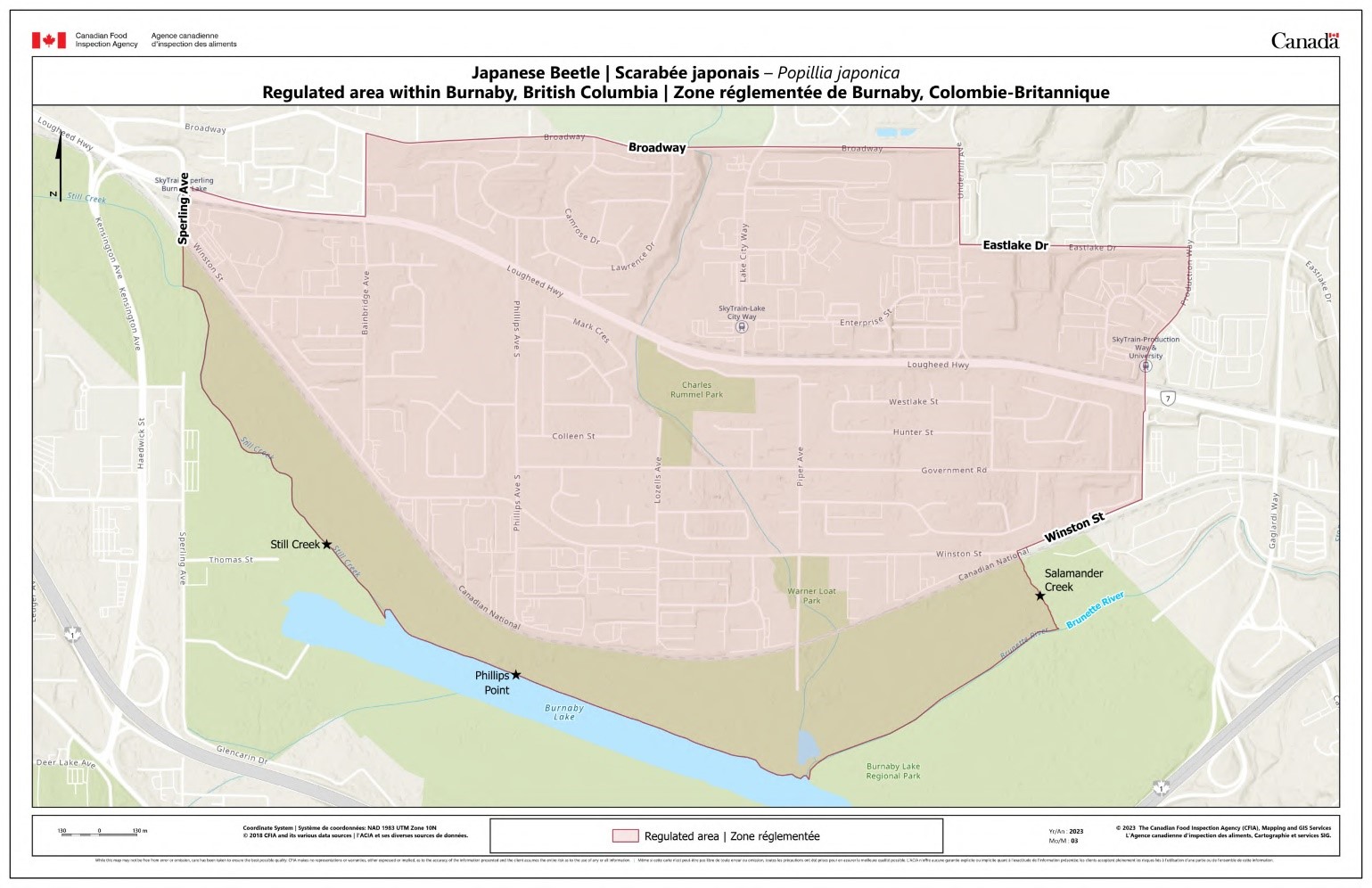
Description of map – Japanese beetle (Popillia japonica) regulated area within Burnaby, British Columbia
This map shows the boundary of the Japanese beetle (Popillia japonica) regulated area in the City of Burnaby, British Columbia. Starting at the point of intersection between Eastlake Drive and Production Way and continuing south until Production Way changes to Brighton Avenue; south to the three-way intersection of Brighton Avenue, Winston Street and Government Street; southwest along Winston Street to the western border of Salamander Creek; south along the western border of Salamander Creek to the northern border of the Brunette River; west along the northern border of Burnaby Lake to Still Creek; northwest along Still Creek to the Central Valley Greenway; north to Sperling Avenue; north to Lougheed Highway; east to Bainbridge Avenue; north to Broadway Street; east to Underhill Avenue; south to Eastlake Drive; and, east until the initial point of intersection between Eastlake Drive and Production Way.
Effective May 5, 2023, the regulated area in the Cities of Coquitlam and Port Coquitlam, BC is defined as follows:
- All parts of the City of Coquitlam, located within the area commencing at the intersection of the high watermark of the Fraser River and proceeding westward to the Coquitlam River;
- Thence proceeding northward along the Coquitlam River to the Millennium and Garden Trail Bridges of Colony Farm Regional Park;
- Thence proceeding westward along the Garden Trail to Colony Farm Road;
- Thence proceeding northward along the centre of Colony Farm Road to Access Road;
- Thence proceeding westward along the centre of Access Road to the southern boundary of Colony Farm Regional Park;
- Thence proceeding westward following the southern boundary of Colony Farm Regional Park to Access Road;
- Thence proceeding westward along the centre of Access Road to the western boundary of Colony Farm Regional Park;
- Thence proceeding northward along the western boundary of Colony Farm Regional Park to Lougheed Highway;
- Thence proceeding northward along the centre of Lougheed Highway to the point where the Coquitlam and Port Coquitlam municipal boundaries meet;
AND
- All parts of the City of Port Coquitlam, located within the area commencing at the point where the Coquitlam and Port Coquitlam municipal boundaries meet along the Lougheed Highway;
- Thence proceeding northeastward to Orchid Drive along the Port Coquitlam municipal boundary to the Coquitlam River;
- Thence proceeding northward along the Coquitlam River to the point in line with Lincoln Avenue and the Port Coquitlam municipal boundary;
- Thence proceeding eastward to the centre of Lincoln Avenue and proceeding to the point where Lincoln Avenue and Oxford Street intersect;
- Thence proceeding northward along the centre of Oxford Street following the municipal boundary of Port Coquitlam to Mason Avenue;
- Thence proceeding eastward along the centre of Mason Avenue and the municipal boundary of Port Coquitlam to Wellington Street;
- Thence proceeding southward along the centre of Wellington Street following along the Port Coquitlam municipal boundary;
- Thence proceeding eastward along the centre of Victoria Drive and the Port Coquitlam municipal boundary to the point where Victoria Drive and Cedar Drive meet;
- Thence proceeding southward following along the municipal boundary of Port Coquitlam to the point where the municipal boundary meets Fremont Street;
- Thence proceeding southward along the centre of Fremont Street until the southern terminus of Fremont Street;
- Thence proceeding eastward from Fremont Street to Burns Road;
- Thence proceeding southward along the centre of Burns Road to Dominion Avenue;
- Thence proceeding eastward along the centre of Dominion Avenue to the Traboulay Poco Trail and the west shoreline of the Pitt River;
- Thence proceeding south along the high watermark of the Pitt River to the confluence of the high watermark of the Fraser River;
- Thence proceeding west along the high watermark of the Fraser River to the initial point of intersection at the Coquitlam River.
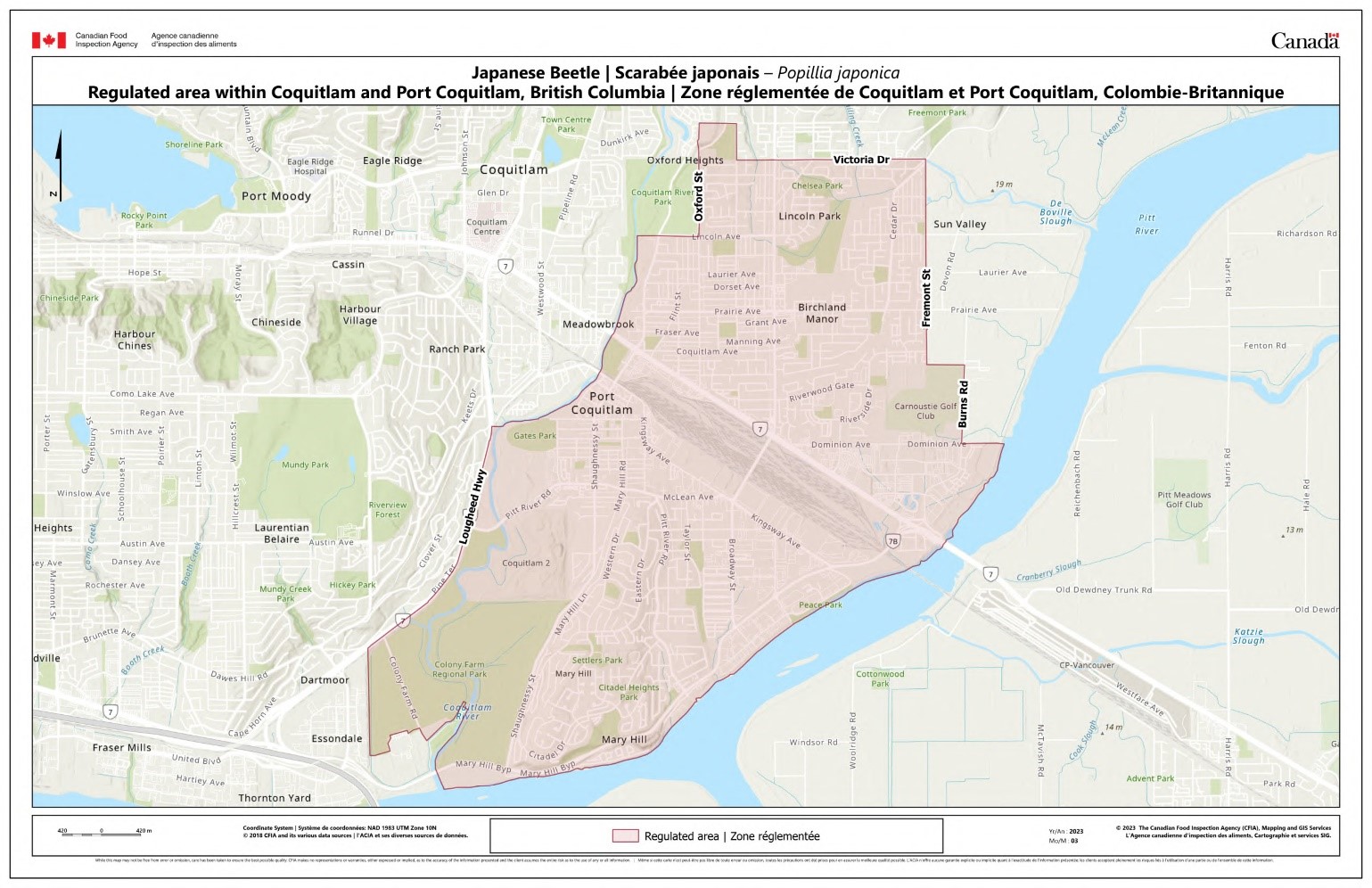
Description of map – Japanese beetle (Popillia japonica) regulated area in the Cities of Coquitlam and Port Coquitlam, British Columbia
This map shows the boundary of the Japanese beetle (Popillia japonica) regulated area in the Cities of Coquitlam and Port Coquitlam, British Columbia. Starting in the City of Coquitlam, at the intersection of the high watermark of the Fraser River and continuing west to the Coquitlam River; north to the Millennium and Garden Trail Bridges of Colony Farm Regional Park; west to Colony Farm Road; north to Access Road; west to the southern boundary of Colony Farm Regional Park; west along the boundary to Access Road; west to the western boundary of Colony Farm Regional Park; north along the boundary to Lougheed Highway; north to the point where the Coquitlam and Port Coquitlam municipal boundaries meet; northeast to Orchid Drive along the Port Coquitlam municipal boundary to the Coquitlam River; north to the point in line with Lincoln Avenue and the Port Coquitlam municipal boundary; east to the centre of Lincoln Avenue and continuing to the point where Lincoln Avenue and Oxford Street intersect; north along Oxford Street following the municipal boundary of Port Coquitlam to Mason Avenue; east to Wellington Street; south along the centre of Wellington Street following along the Port Coquitlam municipal boundary; east along the centre of Victoria Drive and the Port Coquitlam municipal boundary to the point where Victoria Drive and Cedar Drive meet; south along the municipal boundary of Port Coquitlam to the point where the municipal boundary meets Fremont Street; south to the southern terminus of Fremont Street; east to Burns Road; south to Dominion Avenue; east to the Traboulay Poco Trail and the west shoreline of the Pitt River; south along the high watermark of the Pitt River to the confluence of the high watermark of the Fraser River; west along the high watermark of the Fraser River to the initial point of intersection at the Coquitlam River.
Effective May 5, 2023, the regulated area in the City of Vancouver, BC is defined as follows:
- All parts of the City of Vancouver, located within the area commencing at the point of intersection between Knight Street and East 49th Avenue and proceeding westward along the centre of East 49th Avenue to Main Street;
- Thence proceeding westward along the centre of West 49th Avenue to Arbutus Street;
- Thence proceeding southward along the centre of Arbutus Street to West 51st Avenue;
- Thence proceeding eastward along the centre of West 51st Avenue until West 51st Avenue transitions into West Boulevard;
- Thence proceeding southward along the centre of West Boulevard until West Boulevard transitions into Angus Drive;
- Thence proceeding southward along the centre of Angus Drive to Southwest Marine Drive;
- Thence proceeding southeastward along the centre of Southwest Marine Drive to Angus Drive;
- Thence proceeding southward along the centre of Angus Drive crossing West 57th Avenue to the high water mark line of the north arm of the Fraser River;
- Thence following the high watermark northwestward along the shoreline of the north arm of the Fraser River to the Fraser River Trail Musqueam Gateway;
- Thence proceeding northward along the Fraser River Trail Musqueam Gateway to West 51st Avenue
- Thence proceeding eastward along the centre of West 51st Avenue to Dunbar Street;
- Then proceeding northward along the centre of Dunbar Street to West King Edward Avenue;
- Thence proceeding eastward along the centre of West King Edward Avenue to Blenheim Street;
- Thence proceeding northward along the centre of Blenheim Street, crossing Point Grey Road, to the high water mark line of English Bay;
- Thence following the high water mark northeastward along the shoreline of English Bay around Stanley Park and along the shoreline of Burrard Inlet eastward to Commercial Drive;
- Thence proceeding southward along the centre of Commercial Drive until East Broadway;
- Thence proceeding westward along the centre of East Broadway until Clark Drive;
- Thence proceeding southward along the centre of Clark Drive until Clark Drive transitions to Knight Street;
- Thence proceeding southward along the centre of Knight Street to the initial point of intersection of Knight Street and East 49th Avenue.
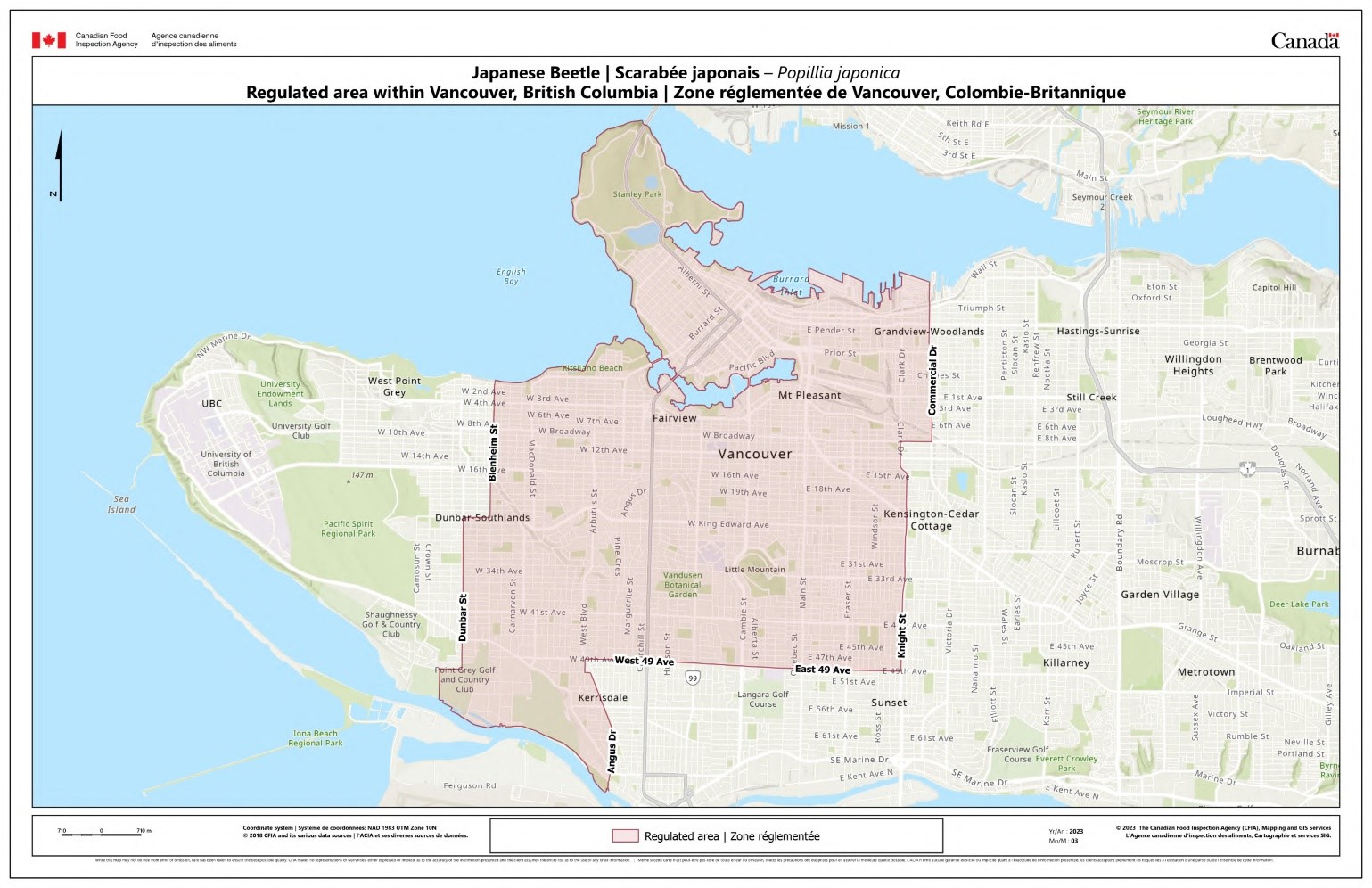
Description of map – Japanese beetle (Popillia japonica) Regulated Area within Vancouver, British Columbia
This map shows the boundary of the Japanese beetle (Popillia japonica) regulated area in the City of Vancouver, British Columbia. Starting in the City of Vancouver at the point of intersection between Knight Street and East 49th Avenue and continuing west to Main Street; west along West 49th Avenue to Arbutus Street; south to the centre of Arbutus Street to West 51st Avenue; east until West 51st Avenue transitions into West Boulevard; south until West Boulevard transitions into Angus Drive; south to Southwest Marine Drive; southeast to Angus Drive; south along the centre of Angus Drive crossing West 57th Avenue to the high water mark line of the north arm of the Fraser River; following the high watermark northwest along the shoreline of the north arm of the Fraser River to the Fraser River Trail Musqueam Gateway; north to West 51st Avenue; east to Dunbar Street; north to West King Edward Avenue; east to Blenheim Street; north, crossing Point Grey Road, to the high water mark line of English Bay; northeast along the shoreline of English Bay around Stanley Park and along the shoreline of Burrard Inlet east to Commercial Drive; south to East Broadway; west to Clark Drive; southwest until Clark Drive transitions to Knight Street; south to the initial point of intersection of Knight Street and East 49th Avenue.
Appendix 3: Application for approval under Japanese beetle programs
Note: This form is for use by the Canadian Food Inspection Agency (CFIA) in approving Canadian growers under one of the Japanese Beetle Programs. Separate forms will be used by the appropriate agencies in the United States for approving American growers.
Application for approval under Japanese Beetle Programs for Canadian Producers
Compliance Agreement & Registration Application Form
A. Contact Information
- Production Facility (Nursery/Greenhouse) Name: __________
- Owner / Manager: __________
(name of person signing this agreement) - Mailing Address: __________
- Street Address: __________
- Telephone: __________
- Email / Fax: __________
Contact information of the CFIA pest control manager and alternate
-
- Primary Contact: __________
- Position / Title: __________
- Telephone: __________
- Email: __________
-
- Alternate Contact: __________
- Position / Title: __________
- Telephone: __________
- Email: __________
Participation in the Japanese Beetle Program(s) must be renewed as needed. The CFIA must receive a completed and signed application form from the facility by April 1st each year. Registration in the Japanese Beetle Program(s) and the Greenhouse Certification Program / Canadian Nursery Certification Program should be coordinated / combined.
B. Japanese Beetle Pest Management Program Options
Please select the Japanese Beetle Pest Management Program(s) for which you are applying and indicate (for each) whether this is your initial application or a renewal of an existing approval:
| - | Initial | Renewal |
|---|---|---|
| Japanese Beetle Pest- Free Greenhouse/Screenhouse Program | checkbox | checkbox |
| Japanese Beetle Greenhouse Plant Program | checkbox | checkbox |
| Japanese Beetle Nursery Management Program | checkbox | checkbox |
| Japanese Beetle Containerized Nursery Stock Program | checkbox | checkbox |
| Japanese Beetle Sod and Turfgrass Program | checkbox | checkbox |
C. Compliance Agreement Requirements for the Japanese beetle Program(s):
- The facility agrees to comply with the specific Program requirements associated with the selected Japanese Beetle Program(s), as described in directive D-96-15: Phytosanitary requirements to prevent the spread of Japanese beetle, Popillia japonica, in Canada and the United States.
- The facility must maintain all documents, records and maps associated with the regulated commodities produced under the Japanese beetle program(s) for five years. Documents, records and maps must be made available to the CFIA upon request.
- The facility will be inspected by the CFIA, at appropriate intervals. The facility agrees to cooperate with these audits.
- The facility agrees to immediately suspend all shipments of regulated commodities to Category 1 and 2 provinces/states if notified by the CFIA that the facility is in non-compliance.
- Approved facilities will be listed on the public CFIA website indicating the facility's status within the program(s). Should a facility be in non-compliance or suspended, the facility's name will be removed from the website and regulated plant material will not be permitted to be shipped to Category 1 and 2 provinces/states.
D. Applicant's statement:
I am the owner/manager and/or the legally authorized representative of the Production Facility.
I have read, understood and agree to comply with all the requirements outlined above and as set out in CFIA directive D-96-15: Phytosanitary requirements to prevent the spread of Japanese beetle, Popillia japonica, in Canada and the United States.
I understand that the information I provide on this document is collected by the Canadian Food Inspection Agency (CFIA) under the authority of the Plant Protection Act for the purpose of preventing the spread of Japanese beetle, Popillia japonica, in Canada and the United States. In relation to this, I understand/acknowledge that my personal information collected by the CFIA under Plant Protection Programs will be dealt with under the provisions of the Privacy Act and will be stored in Personal Information Bank CFIA IPP 155 and this information may be accessible or protected as required under the provisions of the Access to Information Act. I also acknowledge that this information will be retained for a period of 10 years in accordance with the Agency's retention and disposition policies.
__________
Applicant Signature
__________
Printed name
__________
Date
E. Approval Statement from the CFIA (to be completed by a CFIA official)
The above facility has been inspected and complies with all the requirements outlined in this agreement.
Date of inspection: __________
I hereby approve the above-mentioned establishment for participation in the following selected Japanese Beetle Program(s):
- Japanese Beetle Pest-Free Greenhouse/Screenhouse Program
- Japanese Beetle Greenhouse Plant Program
- Japanese Beetle Nursery Management Program
- Japanese Beetle Containerized Nursery Stock Program
- Japanese Beetle Sod and Turfgrass Program
__________
Signature
__________
Printed name
__________
Date
Appendix 4: Facilities approved under a Japanese Beetle Certification Program in Canada
Facilities approved under a Japanese beetle program
- Date modified: