
D-08-01: Certification program for heat-treated/dehydrated shredded or chopped forage products of or containing Hessian Fly (Mayetiola destructor (Say)) host material produced in Canada for export to Japan and the Republic of Korea
This page is part of the Guidance Document Repository (GDR).
Looking for related documents?
Search for related documents in the Guidance Document Repository
Effective date : June 3, 2021 (Third Revision)
Subject
Facilities involved in the exportation of forage products (chopped/shredded hay or straw (densified, baled, ensiled, etc.)) composed of or containing heat treated/dehydrated chopped or shredded Hessian fly (Mayetiola destructor (Say)) host materials produced in Canada are subject to procedures which ensure compliance with the import requirements of Japan's Ministry of Agriculture, Forestry and Fisheries (MAFF) and the Republic of Korea's Animal and Plant Quarantine Agency (APQA). To facilitate the export of such products from Canada to Japan or the Republic of Korea, a compliance agreement between the exporting facility (a facility for processing forage products which has applied for and has been approved to heat treat forage products and which has demonstrated competence to the satisfaction of the Canadian Food Inspection Agency (CFIA) in meeting the conditions and requirements of this program) and the CFIA is required for each country. The agreements are designed to verify that forage products exported from Canada to Japan and the Republic of Korea are treated, stored, handled, transported and labelled according to the requirements of MAFF and APQA.
This directive has been revised to include requirements specific to APQA, that were agreed to in January 2021, update the review date of this document, and make minor administrative changes. The content of this directive with respect to forage exports to Japan, has not changed.
On this page
- ● Review
- ● Endorsement
- ● Amendment Record
- ● Distribution
- ● Introduction
- ● Scope
- ● References
- ● Definitions, abbreviations and acronyms
- 1.0 General requirements
- 1.1 Legislative Authority
- 1.2 Fees
- 1.3 Regulated pests
- 1.4 Regulated Areas
- 1.5 Regulated commodities
- 2.0 Specific requirements
- 2.1 Forages eligible for certification under this program
- 2.2 Plant quarantine import requirements
- 2.3 Heat treatment/dehydration procedure
- 2.4 Facility inspection and certification
- 2.5 Storage, handling, packaging and transportation
- 2.6 Sealing and labelling of shipping containers
- 2.7 Administrative requirements
- 2.7.1 Compliance agreement conditions
- 2.7.2 Record keeping
- 2.7.3 CFIA responsibilities
- 2.8 Phytosanitary certification
- 2.9 Non compliance
- 3.0 Appendices
- Appendix 1: Application and compliance agreement for the certification program for heat-treated/dehydrated shredded or chopped forage products of or containing Hessian Fly host material produced in Canada for export to Japan
- Appendix 2: Application and compliance agreement for the certification program for heat-treated/dehydrated shredded or chopped forage products of or containing Hessian Fly host material produced in Canada for export to the Republic of Korea
- Appendix 3: Templates for container labels (Japan and the Republic of Korea)
- Appendix 4: Quarantine pests regulated by the Republic of Korea Associated with Canadian forages
Review
This directive will be updated as required. For further information or clarification please contact the Canadian Food Inspection Agency (CFIA).
Endorsement
Approved by:
Chief Plant Health Officer
Amendment Record
Amendments of this directive will be dated and distributed as outlined below.
Distribution
CFIA website
Introduction
The production of forage products (for example, hay, straw) for export to foreign markets, such as Japan and the Republic of Korea, is an important industry in Canada and is expected to continue to grow as new markets are developed. Hessian fly (Mayetiola destructor (Say)) is a quarantine pest in Japan and the Republic of Korea. Host material for Hessian fly, including wheat, barley, rye, triticale and wheatgrasses (such as quackgrass), that could potentially harbour the insect, is also prohibited from entering Japan and the Republic of Korea. However, a heat/dehydration treatment has been approved by Japan and the Republic of Korea for Canadian forage products that are or contain Hessian fly host material. The CFIA has developed this phytosanitary certification program to comply with the conditions established by the National Plant Protection Organizations of Japan (MAFF) and the Republic of Korea (APQA) for heat-treated/dehydrated chopped forage products that are or contain Hessian fly host material. The objective of this program is to export forage products which meet the plant quarantine import requirements of Japan and Republic of Korea for freedom from Hessian fly.
This certification program is mandatory for processors, shippers and exporters of forage products that are or contain Hessian fly host material for export to Japan and the Republic of Korea.
Scope
The information in this directive is intended for facilities and companies that export forage products to Japan and the Republic of Korea, and for CFIA inspectors and program officers.
References
- Announcement of the Ministry of Agriculture, Forestry and Fisheries No. 764 provided for in Schedule 2 of the Enforcement Regulations of Plant Protection Law (1950, Ordinance of Ministry of Agriculture and Forestry No.73 (Japan: June 7, 2007).
- D‑03-14: Canadian Hay Certification Program to certify hay for export
- International Standard for Phytosanitary Measures (ISPM) No. 5: Glossary of phytosanitary terms; International Plant Protection Convention, FAO, Rome. (updated annually).
- All other directives relating to phytosanitary requirements for field crop commodities may be found at Plant Protection Policy Directives - Grains and oilseeds.
Definitions, abbreviations and acronyms
Definitions for terms used in the present document can be found in the plant health glossary of terms.
1.0 General requirements
1.1 Legislative Authority
- Administrative Monetary Penalties Act, S.C. 1995, c. 40
- Canadian Food Inspection Agency Act, S.C. 1997, c. 6
- Plant Protection Act, S.C. 1990, c. 22
- Plant Protection Regulations, SOR/95-212
- Canadian Food Inspection Agency Fees Notice, Canada Gazette: Part I (as amended from time to time)
1.2 Fees
The CFIA is charging fees in accordance with the Canadian Food Inspection Agency Fees Notice. Anyone requiring further information regarding fees may contact any local CFIA office at or visit our fees notice website.
1.3 Regulated pests
Hessian fly (Mayetiola destructor (Say)) and other quarantine insect species regulated by the importing country in the commodity being exported (see Appendix 4).
1.4 Regulated Areas
Canada (all areas).
1.5 Regulated commodities
Shredded/chopped forage of Hessian fly host material or forage containing Hessian fly host material produced in Canada. This includes:
- wheat
- barley
- rye
- triticale
- wheatgrasses (such as quackgrass)
2.0 Specific requirements
In order for a facility to be approved under this certification program, the facility must apply for approval to the CFIA and have a Quality Management System in place to ensure that only forage products eligible for export are presented for phytosanitary certification.
As the national plant protection organization of Canada, the CFIA will be responsible for certifying heat-drying facilities and for developing and maintaining a list of approved facilities. On an annual basis, the lists will be submitted to the MAFF of Japan and APQA for the Republic of Korea. A confirmatory inspection or audit of the facility by an inspector from the approving country (MAFF or APQA as appropriate) will be required prior to final approval.
2.1 Forages eligible for certification under this program
Chopped/shredded straw or hay composed of or contaminated with hosts of Hessian fly (Mayetiola destructor) grown in Canada and treated according to the heat treatment/dehydration certification compliance agreement are eligible for export to Japan and the Republic of Korea, including:
- straw
- culm (stem)
- leaves of wheat (Triticum spp.)
- barley (Hordeum spp.)
- rye (Secale spp.)
- wheatgrasses (Agropyron spp.)
Notes:
- Baled and/or long hay and straw are not eligible products under this program.
- Approved species of baled hay not contaminated with hosts of Hessian fly can continue to be imported into Japan and the Republic of Korea under visual inspection as per D-03-14: Canadian Hay Certification Program to certify hay for export.
2.2 Plant quarantine import requirements
Quarantine pests are normally listed in the importing country's plant quarantine import requirements as prohibited pests. All forage products must meet the plant quarantine import requirements of Japan and the Republic of Korea, as follows:
Forage products must be free from:
- Soil
- Quarantine pests (for example, Hessian fly) based on the heat treatment protocol outlined in this directive and implemented by participating facilities as per the compliance agreement with CFIA
- Other visible pests (specific quarantine pests of the Republic of Korea as specified in Appendix 4)
2.3 Heat treatment/dehydration procedure
To be eligible for this certification program, facilities must follow the procedures outlined below:
- The heat treatment/dehydrating process at the facilities shall be implemented by supplying hot air into the rotating drum and moving the forage product through the drum with the stream of hot air
- The forage product will be subjected to an air temperature of at least 90° C.
- A digital automatic recording thermometer shall be installed at or near the outlet of the drum to monitor the exhaust gas temperature, and temperatures will be automatically recorded
- The exhaust gas temperature at the outlet of the drum shall should be maintained at 90° C or higher
- When the exhaust gas temperature at the outlet of the drum reaches 90° C or higher, the temperature inside of the drum is maintained at 90° C or higher such that the treated product leaving the drum has been subjected to a temperature of at least 90° C
- For exports to the Republic of Korea: The temperature of the heat treatment drum must be maintained at 90 °C or higher, and the retention time for forage material from when it is introduced into the rotary drum until it exits the cyclone separator must be guaranteed to exceed 100 seconds
2.4 Facility inspection and certification
-
At least once per year and always at the beginning of annual production (processing of new crop forages) the facility shall be inspected by the CFIA to:
- Confirm that the readings of the automatic recording thermometer at the outlet of the drum are accurate, through the verification of thermocouple calibration(s) performed by a recognized instrumentation company
- Confirm that the exhaust gas temperature at the outlet of the drum reaches 90° C or higher and that the temperature is maintained and recorded during treatment
- Verify the records of the exhaust gas temperature at the outlet of the drum to confirm that treatment has been implemented appropriately , through the auditing of heat treatment records for forage lots processed for export to Japan and the Republic of Korea
-
The CFIA will continue to work in collaboration with MAFF and APQA regarding the frequency of joint facility audits of established facilities under this program.
-
The following records for each treatment conducted must be kept by the facility and submitted to the CFIA as part of the inspection and certification process:
- Quality Management System procedures
- Exhaust gas temperature data from the outlet of the drum at each facility for each treatment conducted (Exhaust temperature records are maintained for each forage lot processed)
- Quantity of material treated
- Quantity of treated material in storage
- Number of packages exported
- Copies of the package tags
For the purpose of this certification program, a package is defined as either an individual unit (for example, bale, bag, container), or a collection of such units that are bound together such that the bundle integrity is maintained through export (for example, a pallet of bales that has been wrapped in plastic).
2.5 Storage, handling, packaging and transportation
-
The packaging and storage areas should be used exclusively for forage products that have been heat treated/dehydrated under this certification program.
-
Untreated and treated products must be stored separately and the storage facilities must be contained and able to be secured. This may require loading the treated product directly into shipping containers.
-
The storage facilities must be clean, and, if necessary, disinfected using an approved pesticide.
-
Each package, either an individual unit (for example, bale, bag contained) or a collection of such units that are bound together such that the bundle integrity is maintained through export (for example, a pallet or bales that has been wrapped in plastic) shall bear a tag or label indicating:
- Identity of forage species
- Date of treatment
- The name, address and CFIA issued facility identification number
- The lot number (for example, barcode, stamp, etc.) should also be clearly indicated on the tag or label of each package
Export shipments to Japan:
The tag or label should state the information in this manner: This (insert identity of forage material and lot number) has been heat treated/dehydrated on (insert date of treatment) at a temperature of 90°C or higher at (insert heat treatment/dehydration facility name, address and CFIA issued facility identification number) that has been designated by the Canadian Food Inspection Agency.
Export shipments to the Republic of Korea:
The tag or label should state the information in this manner: This (insert identity of forage material and lot number) has been heat treated/dehydrated on (insert date of treatment) as per the Heat Treated Hay Export Program at (insert facility name, address and CFIA issued facility identification number) that has been designated by the Canadian Food Inspection Agency.
-
During transportation of the treated forage products to the temporary storage within the facility or to the vessel loading location, measures should be taken to prevent re-infestation by Hessian flies or untreated Hessian fly host material.
2.6 Sealing and labelling of shipping containers
The material will be exported in ocean freight containers. Containers of heat-treated/ dehydrated forage products shall be sealed under the oversight of the CFIA and subject to audit. The seal and container number shall be recorded on the Phytosanitary Certificate. A bilingual label (Appendix 3) must be affixed to each ocean shipping container by CFIA or officials authorized by CFIA. The labels must include the following information:
- CFIA logo
- CFIA issued facility number
- The following text in English and French: "Certified Export Forage Product for Japan" or "Certified Export Forage Product for the Republic of Korea"
The use of the label indicates that the consignment has been certified for export to either Japan or the Republic of Korea. The container labels will be issued to the facility by a CFIA approved provider and label costs will be borne by the exporter. Container labels must be securely fastened to the outside of the container and clearly visible.
2.7 Administrative requirements
2.7.1 Compliance agreement conditions
In order for a facility to be approved to participate in this certification program to export heat treated/dehydrated chopped/shredded forage products to Japan and the Republic of Korea, the facility shall be approved by the CFIA under a compliance agreement. The compliance agreement conditions are presented in Appendixes 1 and 2. Failure to comply with the conditions set out in this agreement will result in the revocation of the facility's certification.
2.7.2 Record keeping
CFIA personnel in area/regional offices will maintain the files on and records from each approved facility participating in this program for a period of no less than 3 years.
Records on each approved facility shall include:
- Application for approval under the Heat Treated Forage Program (1 copy)
- Compliance Agreement (1 copy of signed agreement)
- The facility inspection reports
- The exhaust gas temperature data from the outlet of the drum for each treatment conducted
- The quantity of material disinfected
- The quantities moved into and out of packaging and temporary storage facilities
- Copies of the package tags
- The number of packages exported
The number of Phytosanitary Certificates issued for this type of product (including copies of each Phytosantiary Certificate)
2.7.3 CFIA responsibilities
The CFIA program officer or inspector is responsible for evaluating the facility application (Appendixes 1 or 2), inspecting and auditing facilities, approving Quality Management System procedures, obtaining signatures for compliance documents and retaining the required facility records. The final decision to approve the facility should be made by the Regional Program Officer through the signing of the compliance agreement and the issuance of an approval letter to the facility.
A signed copy of the compliance agreement and letter shall be sent to the National Manager, Grains and Potatoes section, International Affairs Branch. Once a facility is approved, the National Manager will forward its name to MAFF and/or APQA in order to have the facility recognized as an authorized exporter of heat treated/dehydrated forage products to Japan and/or the Republic of Korea. A list of all authorized exporters will be maintained and forwarded to MAFF and/or APQA on an annual basis.
2.8 Phytosanitary certification
Prior to export of a consignment, exporters of forage products must complete and submit an Application for Phytosanitary Certification to the CFIA. A Phytosanitary Certificate will be issued by the CFIA for each shipment in accordance with D-99-06: Policy on the issuance of Phytosanitary Certificates, once it has been determined that the consignment meets the requirements of Japan and the Republic of Korea. The Phytosanitary Certificate will specifically state that the forage product is not infested with Hessian flies based on the heat treatment conducted as per the specifications in this program.
Details of the heat treatment will be included on the certificate using the following statements for Japan and the Republic of Korea:
- Japan: "This shipment is free of Hessian fly (Mayetolia destructor) based on heat treatment performed at a temperature of 90 degrees C or higher at a heat-drying facility designated by the Canadian Food Inspection Agency". The name and address of the facility and the date of the treatment must be provided on the Phytosanitary Certificate.
- Republic of Korea: "This shipment is free of Hessian fly (Mayetolia destructor) based on heat treatment performed at a temperature of 90 degrees C at a heat-drying facility designated by the Canadian Food Inspection Agency". The name and address of the facility and the date of the treatment must be provided on the Phytosanitary Certificate.
2.9 Non compliance
If any problem occurs in relation to the heat treatment certification program, CFIA shall investigate the cause(s) immediately, and ensure that corrective measures are implemented. Any forage material determined to not have been treated as per the requirements of the program, will not be eligible for certification under the heat treatment program. If MAFF or APQA determine that a facility audit is required under this program, an on-site audit may be conducted at any time. In this case, the expenses for the audit will be borne by the Canadian side.
In addition, where CFIA inspections determine that an approved facility does not meet the conditions of the compliance agreement, its approval status will be revoked. The CFIA program officer will notify the approved facility in writing of this action.
A facility which has had its approval revoked may re-apply to participate in this certification program once all necessary corrective actions have been implemented. A detailed report of the corrective actions taken must be submitted to the CFIA for evaluation. A CFIA inspector will inspect the facility to determine whether corrective actions are sufficient.
3.0 Appendices
Appendix 1: Application and compliance agreement for the certification program for heat-treated/dehydrated shredded or chopped forage products of or containing Hessian Fly host material produced in Canada for export to Japan
Name of facility: ____________________
Owner/operator of facility: ____________________
Operations manager: ____________________
Address: ____________________
Telephone number: ____________________
Fax number: ____________________
Review and approval of Quality Management System procedures commendation of Applicant for participation in program
____________________
Signature and printed name
CFIA Inspector/Officer
____________________
Location
____________________
Date
Facility inspection completed and facility recommended for approval by:
____________________
Signature and printed name
CFIA Inspector/Officer
____________________
Location
____________________
Date
Compliance agreement between the Canadian Food Inspection Agency and Canadian facilities intending to export heat-treated/dehydrated shredded or chopped forage products of or containing Hessian fly host material produced in Canada to Japan
The Canadian Food Inspection Agency (CFIA) verifies that (facility name) meets the compliance standards based on the following criteria:
- A rotating drum is used in the heat treatment/dehydration such that the forage product moves under a continuous flow of hot air and reaches 90° C.
- A digital automatic recording thermometer is installed at the outlet of the drum.
- The exhaust gas temperature at the outlet of the drum is maintained at a designated temperature such that the temperature in the drum is 90° C or higher.
- The treated product is maintained in isolation from non-treated product throughout the post-treatment handling, storage and transportation system.
- Measures for preventing contamination of compliant with non-compliant forage product and for preventing the export of non-compliant forage products to Japan must be in place.
- Storage areas must be cleaned prior to and after use to avoid contaminating treated forage product with untreated product.
- Records for each shipment of forage products must be submitted to the CFIA. The records will include: origin, species, type and quantity of forage material, quantity of material treated, date of treatment, treatment details, where stored, duration of storage, when shipped, lot number of finished product.
- A document tracking process as part of the Quality Management System procedures to show traceability of forage product lots from arrival at facility through to the final exported product is in place.
- The facility has the capacity to ensure that each package [either an individual unit (for example, bale, bag contained) or, a collection of such units that are bound together such that the bundle integrity is maintained through export (for example, a pallet or bales that has been wrapped in plastic)] for export bears a tag or label indicating: "This (insert identity of forage material) has been heat treated/dehydrated on (insert date of treatment) at a temperature of 90° C or higher at (insert heat treatment/dehydration facility name, address and CFIA issued facility identification number) that has been designated by the Canadian Food Inspection Agency."
- The lot number of the finished product is clearly visible on the label of each package to facilitate trace-back.
I, (insert name), the owner/operator in possession, care, or control of the above named facility have read and understood all the terms, conditions, obligations and requirements stated herein by which I may be approved to export approved forage product(s) in accordance with Directive 08-01: Certification Program for Heat-Treated/Dehydrated Shredded or Chopped Forage Products of or Containing Hessian Fly (Mayetiola destructor (Say)) Host Material Produced in Canada for Export to Japan and the Republic of Korea.
Further, I am and shall be responsible for and shall indemnify and save harmless Her Majesty the Queen in Right of Canada, including the Canadian Food Inspection Agency, Her Officers, Servants, Employees, Successors and Assigns, from and against all manners of actions, causes of action, claims, demands, loss, costs, damages, actions or other proceedings by whomsoever made, sustained, brought or prosecuted in any manner based upon, caused by, arising out of, attributable to or with respect to any failure, inadvertent or otherwise, by act or omission, to fully comply with the said conditions and requirements.
Exporter (or Representative) signature ____________________
Printed name and title ____________________
____________________
Location
____________________
Date
____________________
CFIA inspector signature and printed name
____________________
Location
____________________
Date
____________________
Regional Program Officer signature and printed name
____________________
Location
____________________
Date
Appendix 2: Application and compliance agreement for the certification program for heat-treated/dehydrated shredded or chopped forage products of or containing Hessian Fly host material produced in Canada for export to the Republic of Korea
Name of facility: ____________________
Owner/operator of facility: ____________________
Operations manager: ____________________
Address: ____________________
Telephone number: ____________________
Fax number: ____________________
Review and approval of Quality Management System procedures commendation of applicant for participation in program
____________________
Signature and printed name
CFIA Inspector/Officer
____________________
Location
____________________
Date
Facility inspection completed and facility recommended for approval by:
____________________
Signature and printed name
CFIA Inspector/Officer
____________________
Location
____________________
Date
Compliance agreement between the Canadian Food Inspection Agency and Canadian facilities intending to export heat-treated/dehydrated shredded or chopped forage products of or containing Hessian fly host material produced in Canada to the Republic of Korea
The following information is captured on the form:
The Canadian Food Inspection Agency (CFIA) verifies that (insert facility name) meets the compliance standards based on the following criteria:
- A rotating drum is used in the heat treatment/dehydration such that the forage product moves under a continuous flow of hot air and reaches 90° C.
- A digital automatic recording thermometer is installed at the outlet of the drum.
- The exhaust gas temperature at the outlet of the drum is maintained at a designated temperature such that the temperature in the drum is 90° C or higher and the retention time from when it is introduced into the rotary drum until it exits the cyclone must be guaranteed to exceed 100 seconds.
- The treated product is maintained in isolation from non-treated product throughout the post-treatment handling, storage and transportation system.
- Measures for preventing contamination of compliant with non-compliant forage product and for preventing the export of non-compliant forage products to the Republic of Korea must be in place.
- Storage areas must be cleaned prior to and after use to avoid contaminating treated forage product with untreated product.
- Records for each shipment of forage products must be submitted to the CFIA. The records will include: origin, species, type and quantity of forage material, quantity of material treated, date of treatment, treatment details, where stored, duration of storage, when shipped, lot number of finished product.
- A document tracking process as part of the Quality Management System procedures to show traceability of forage product lots from arrival at facility through to the final exported product is in place.
- The facility has the capacity to ensure that each package [either an individual unit (for example, bale, bag contained) or, a collection of such units that are bound together such that the bundle integrity is maintained through export (for example, a pallet or bales that has been wrapped in plastic)] for export bears a tag or label indicating: "This (insert identity of forage material and lot number) has been heat treated/dehydrated on (date of treatment) as per the Heat Treated Hay Export Program at (insert facility name, address and CFIA issued facility identification number) that has been designated by the Canadian Food Inspection Agency."
- The lot number of the finished product is clearly visible on the label of each package to facilitate trace-back.
I, (insert name), the owner/operator in possession, care, or control of the above named facility have read and understood all the terms, conditions, obligations and requirements stated herein by which I may be approved to export approved forage product(s) in accordance with Certification Program for Heat Treated/Dehydrated Shredded/Chopped Forage Products Produced in Canada Which Are or Contain Hessian Fly Host Material
Further, I am and shall be responsible for and shall indemnify and save harmless Her Majesty the Queen in Right of Canada, including the Canadian Food Inspection Agency, Her Officers, Servants, Employees, Successors and Assigns, from and against all manners of actions, causes of action, claims, demands, loss, costs, damages, actions or other proceedings by whomsoever made, sustained, brought or prosecuted in any manner based upon, caused by, arising out of, attributable to or with respect to any failure, inadvertent or otherwise, by act or omission, to fully comply with the said conditions and requirements.
Exporter (or Representative) signature ____________________
Printed name and title ____________________
____________________
Location
____________________
Date
____________________
CFIA inspector signature and printed name
____________________
Location
____________________
Date
____________________
Regional Program Officer signature and printed name
____________________
Location
____________________
Date
Appendix 3: Templates for container labels (Japan and the Republic of Korea)
These are examples of the bilingual labels that must be placed on the outside of the ocean shipping container for export shipments to Japan and the Republic of Korea, that must include the following information:
- The CFIA logo
- The CFIA issued facility identification number (example: CFIA issued facility number: CHTDFP XXX)
Japan
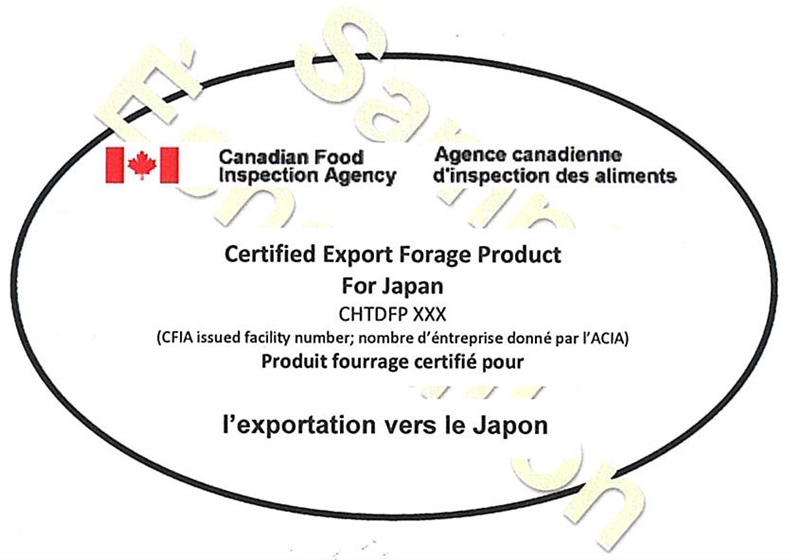
Description for photo - Certified Export Forage Product for Japan
This image is of a bilingual label that would be placed on the outside of ocean shipping containers. It provides information such as the Federal Identity Program image for the CFIA (a Canadian flag with its name on its right side), below in the center it states that it is a "Certified Export Forage Product for Japan", and it provides a space for the issued facility identification number (CHTDFP XXX). All of the information is contained in an oval outlined in black with a cream-coloured watermark over the image stating in French and English that it is a sample.
Republic of Korea
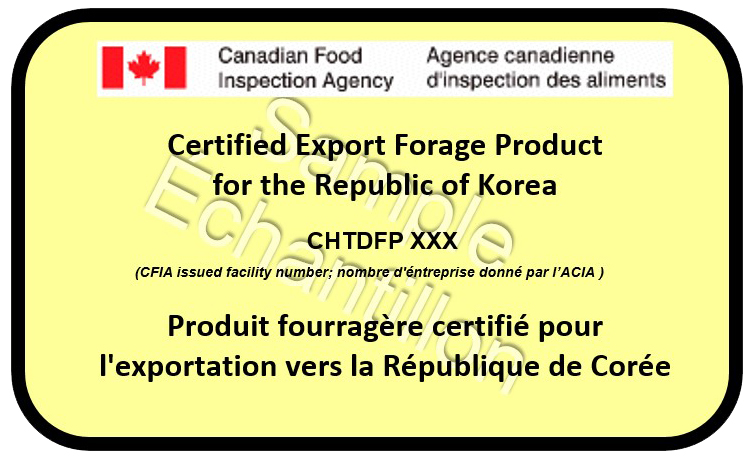
Description for photo - Certified Export Forage Product for the Republic of Korea
This image is of a bilingual label that would be placed on the outside of ocean shipping containers. It provides information such as the Federal Identity Program image for the CFIA (a Canadian flag with its name on its right side), below in the center it states that it is a "Certified Export Forage Product for the Republic of Korea", and it provides a space for the issued facility identification number (CHTDFP XXX). All of the information is contained in rectangle outlined in black with a cream-coloured watermark over the image stating in French and English that it is a sample.
Appendix 4: Quarantine pests regulated by the Republic of Korea Associated with Canadian forages
Quarantine pests regulated by the Republic of Korea associated with Canadian forages
- Abaracus hystrix
- Aceria tosichella
- Penthaleus major
- Tetranychus sinhai
- Labops hesperius
- Javesella pellucida
- Frankliniella tritici
- Limothrips cerealium
- Limothrips denticornis
- Listronotus montanus
- Sphenophorus spp.
- Delia coarctata
- Hylemya cerealis
- Mayetiola destructorFootnote *
- Meromyza americana
- Oscinella soror
- Ostrinia nubilalis
- Hydraecia micacea
- Mythimna unipuncta
- Cephus cinctus
- Cephus pygmeus
- Harmolita secale
- Tetramesa tritici
- Date modified: